




03.12.2025
Don't forget to pay for the garbage collection service!!!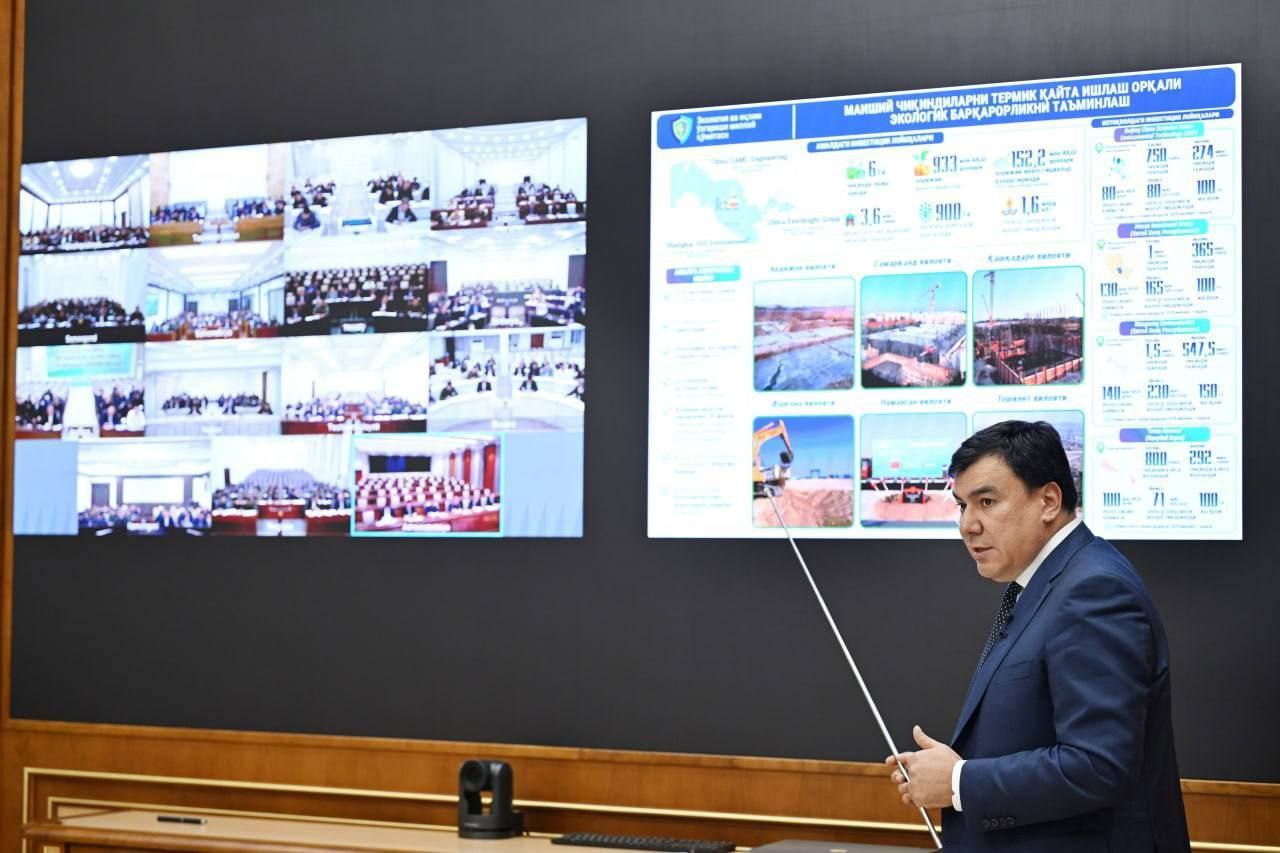 2025-12-02
The President discussed the issue of waste management.
A meeting was held under the President of the Republic of Uzbekistan Shavkat Mirziyoyev.
The meeting discussed in detail issues related to ensuring ecological stability, including waste recycling, and heard reports from responsible officials on preparations for the winter season.
The meeting began with a report from the Special Commission for Improving the Environmental Situation in Tashkent. Measures taken to combat air pollution, identify sources of pollution, and eliminate them were discussed.
As noted, in recent days the influence of a cold anticyclone has been intensifying over the country's territory. As a result, atmospheric pressure increases, temperatures decrease, and inversion phenomena intensify. Under such conditions, small particles do not rise upward and accumulate in the lower layers of air. It was noted that due to meteorological conditions, the natural purification of the atmosphere is slowing down.
Information was presented on the work being carried out to identify sources of air pollution and limit their activities. Specifically, inspections were conducted of greenhouses, construction sites, vehicles, and illegal activity; stabilization measures such as street irrigation, irrigation ditches, and fountain activation were implemented. Intensified raids and preventative measures are continuing.
The President instructed that these measures must be continued not only in the capital but also in the regions, promptly addressing any identified violations, and ensuring strict control of all factors affecting air quality.
Waste-to-energy projects worth $933 million have been launched in six regions – Andijan, Namangan, Fergana, Samarkand, Kashkadarya, and Tashkent – but no significant progress has been observed in other regions. Provision of infrastructure – roads, electricity, and water supply, has not been adequately organized for investors in the projects already underway.
Regional khokimiyats and the National Ecology Committee have been instructed to address existing deficiencies and launch similar projects in the remaining regions next year.
By 2030, the number of solid waste landfills is planned to be reduced by 50 percent. In recent years, 47 landfills have been closed and reclaimed, returning 243 hectares of land to nature.
However, most of the 132 operating landfills still lack protective fencing, green belts, water supply systems, and environmental safety facilities.
- This negatively impacts the environment and causes public discontent. Therefore, solid waste landfills must be transformed into environmentally safe zones. Above all, we must ensure public satisfaction in this area. This issue should be approached not only as a matter of waste management, but also as a field closely linked to industry, energy, and environmental awareness,- emphasized the President.
Responsible managers have been instructed to put the lands of the 47 reclaimed landfills into economic circulation, create "green zones" there, and implement new investment projects. A "green belt" must be created around all existing landfills, with tree and sapling planting completed at half the sites in the spring and at the other half in the fall.
Starting in 2026, at least 150 billion soums will be allocated annually from the budget for these efforts.
Over the past two years, the recycling rate of previously non-recyclable industrial and hazardous waste has increased to 4.5 percent. The insufficiency of this indicator was noted. Instructions have been given to conduct an inventory of industrial and hazardous waste generation and storage sites and to implement at least one project for their recycling and disposal. A unified information and monitoring platform for hazardous waste control has also been instructed to be created.
At the meeting, it was noted that shortcomings in providing the population with liquefied natural gas on preferential terms remain, and instances of theft are still being reported. The "Khududgaztaminot" system has been tasked with eliminating such incidents, working in each district and addressing the population's concerns. Instructions have been given to conduct an inventory of worn-out electrical networks and transformers operating under overload and to ensure their stable operation.
It was established that repairs were performed poorly on 1,800 kilometers of electrical networks. The General Prosecutor’s Office has been instructed to investigate these cases and ensure the rule of law, while the Energy Inspectorate has been instructed to restructure its oversight activities based on new approaches and transition to emergency operations.
The need for uninterrupted energy supply to residents during the winter season was emphasized.
Fire safety issues were also addressed.
It was noted that a full study of the fire safety situation in more than 44,000 multi-story buildings across the country is necessary, and the emergency response system must be prepared for potential risks.
The need to introduce strict legislative requirements prohibiting the use of flammable materials on the exterior walls of buildings was also emphasized. In this regard, it has been instructed to develop a draft law to bring building codes and fire safety regulations in multi-story buildings into line with international practice and to increase the liability of officials.
Issues related to coordinating the work of public utilities and improving the emergency response system were discussed. Based on the experience of the past season, instructions were given to form working groups across districts throughout the republic, integrate all utility services and management service companies into the Ministry of Emergency Situations' dispatch system, and strengthen door-to-door preventative work.

Address: Tashkent city, Uchtepa district, industrial zone Bekabad
number of Dispatcher: (71)247-02-11 (71)247-79-21
Personal Area: https://cabinet.tozamakon.eco
E-mail: maxsustrans@inbox.ru

© 2014-2019 SUE "MAXSUSTRANS"